It’s been about twelve weeks since I left my faculty job in South Africa. I really liked teaching there, partly because the weight of the Apartheid past was still so very present in Stellenbosch that, in an unexpected way, it made it feel especially worthwhile to teach critical social science. But it was just too far from my partner and our kid, who had stayed here. Obviously, we had explored different options. Leaving Stellenbosch ended up being the right thing, and I’m not ambivalent about it, even though I miss the teaching.
Here’s what I wrote on Facebook as I was leaving:
I made so many mistakes in the classroom this year, but for obscure reasons, I also really fell in love with teaching in South Africa, so much that I’m in tears now, writing this. My colleagues told me to be ambitious and teach what I thought was challenging, which was the opposite of my postdoc, where my boss said the students were pretty mediocre and not to expect much. Here I got less afraid of the classroom, and more in touch with which boundaries I need and which ones I don’t. I got better at being myself, at accepting the mistakes and fixing them, at being reflexive in front of the students, and at managing bad affects (mine & other people’s). Some students didn’t like my act and some loved it, and sometimes their critiques of my classes were spot on, and sometimes they came from detached kids who rarely showed up. I think I got better at hearing the critiques and doing my best and just feeling… alive. I don’t necessarily know what people thought or what they took away, and that indeterminacy is important. Teaching is a modest project. But I want to believe that when I was more present, they were more present too. Sometimes I could see it in their faces, I thought; and to my considerable delight, a lot of supposedly “bad students” sneakily turned out to be pretty good ethnographers.
To leave a place is to figure out how to acknowledge your losses, to learn what you will miss.
That experience also taught me, contrary to what I’d imagined, that mixed feelings are not the same thing as ambivalence. Ambivalence in the strong sense, I think, only emerges when mixed feelings are also in conflict with each other, or express some contradiction. But you can feel happy and sad at the same time without having this sense of unresolution that ambivalence provides. Ambivalence is a way of deferring the solutions to struggles, of keeping contradictions open (sometimes, of course, it is an permanent deferral). But me, I’m at peace with my mixed feelings.
Still, on a professional front, it was very hard to leave a teaching job without having another one figured out first. I hope I can find a new university position in America, but we’ll see, since the academic job market in my field is still pretty meager. I still think my work is good. But I’m still writing about precarity, and experiencing it.
We often think of precarity as meaning short-term work contracts, but oddly, when I was at Stellenbosch, I had a permanent academic position, but it was still precarious because the geography was so incompatible with my life realities. The trip, one way, was 25 hours and three flights, minimum.
I liked my colleagues and I’m happy that I’m going to stay affiliated with my department in Stellenbosch for the next few years. I’ll go back and visit, maybe even teach a short course.
Meanwhile, I’m doing much more childcare, and trying to finish my book about French disappointed utopians. There are a lot of coffeeshops in this neighborhood, which constitutes a sort of college town for Case Western Reserve University. Maybe I’ll write more about this neighborhood, with its odd class markers and its unusual (for America) degree of racial diversity. The spaces around universities always bring out my ethnographic instincts.
]]>
Want to comment? Please be aware that only comments from current AAA members will be approved. AN is supported by member dues, so discussions on anthropology-news.org are moderated to ensure that current members are commenting. As with all AN content, comments reflect the views of the person who submitted the comment only. The approval of a comment to go live does not signify endorsement by AN or the AAA.
On the one hand, this only means that anthropologists who can’t afford the Association’s exorbitant annual dues are going to be further excluded from the Association’s public forums. (There are rumors that many anthropologists only pay the annual dues in years when they are attending the Annual Meetings, because otherwise membership confers few useful benefits.) I am certain that no one is going to be incentivized to join the AAA merely to write a comment on this site, which implies that policy constitutes a harmful form of economic exclusion within the profession without any identifiable upside.
But on the other hand — and even more importantly — this commenting policy just further emphasizes the Association’s paleolithic relationship to technology (cf. their latest tech fail), and in particular their weak grasp on the culture of web publicity. Websites like AN are public spaces. There are cultural norms about how online discussions work in such spaces. It flagrantly disrespects these norms to provide public commenting facilities — as on any blog-like site — and then to deliberately reject all comments by non-dues-paying members.
To be clear: you don’t charge people cash to comment on your articles, because they are already giving you something for free by writing their comments. To comment is to contribute. To comment is to create a space of exchange where otherwise you just have a one-way transmission into the digital void. It’s fair to ask people to create accounts before commenting, to cut down on abuse, but there’s little precedent for making it into a cash transaction.
If you want to have members-only web forums, the generic convention is to hide them behind a login screen for members, instead of coupling a public comment box to an anti-public message. Thus the current policy is both hostile to the digital public and out of touch with web culture.
]]>
I’ve long had a memory of having seen this complaint crop up in earlier decades, and I just stumbled back across its source in a 1969 paper by Donald Campbell (in which he critiques the “ethnocentrism of disciplines” and advocates a “fish scale model of omniscience,” but that’s another story). Here’s Campbell critiquing the “scholarly ego ideal”:
]]>While on the theme of recreational reading and the duplication of fish scales, it seems appropriate to deplore the tendency of social scientists to feel that they all should read current newspapers, particularly the New York Times. Certainly the collective perspective would be better if most spent the equivalent time with newspapers of other epochs or with historical, anthropological, archaeological, or literary descriptions of quite other samples of social milieus. Rather than the ego ideal of keeping up with the current worldwide social developments, the young scholar should hold the ideal of foregoing current informedness for some infrequently sampled descriptive recreational literature. Too often our ego-ideals settle for uniform omniscience, knowledge of both past and present, of both here and there, and too often we settle for the same pattern of compromise all our colleagues are settling for. Compromise from the Leonardesque aspiration there must be, but even in leisure reading, one can hold as ideal the achieving of unique compromises.
The motivations for academic work are similarly supposed to be other than pecuniary. One is supposed to work for existential reasons, or out of commitments to higher values that go beyond the purely economic — the “pursuit of knowledge” in some quarters, the dedication to making citizens or producing social justice in others. Yet it’s no criticism of these values to observe, as many have already observed, that these higher values can become alibis for an amplified self-exploitation. “You’re doing it out of personal commitment,” they tell you as you donate your weekend to the institution.
A strange moment in this process, though, is the moment where colleges and universities beg their own employees for charitable donations.
Thus I’ve been surprised to receive email and paper mail requests numerous times per year from my current employer, Whittier College, originating in their Office of Advancement. As the illustration for this post shows, they even emailed me before the end of 2016 to suggest that “Charitable giving might help reduce your income tax bill.” But the only reason I have a tax bill is because they themselves are paying me a salary. So if I gave them a donation, that would … essentially be returning a portion of my salary to my employer.
Which amounts to asking me to work for free, or anyway for less, as if, again, academic work wasn’t actually something you do for a living. (I say “for a living” and not “for the money” to signal that what motivates me is the practical survival of our household, rather than money for its own sake. For people motivated by the latter goal, academia is obviously an inefficient route.) In any event, this seems a strange message to send to one’s employees. The same thing used to happen when I worked at the University of Chicago, so it isn’t just Whittier College in question; but in that case at least I was actually an alumnus.
I would recommend to academic employers that they at least ask their employees to opt in to the list of prospective donors, rather than giving their names to Institutional Advancement purely because of the mere fact of their employment.
]]>
- A License of 3 years is approximately analogous to an American Bachelor’s.
- A 2-year Master, similar to an American Master’s, can be either a “Research Master” or a “Professional Master.”
- The Doctorat (Ph.D.) theoretically takes 3 years, but often more, after which one gets to be called Docteur. (The doctorate in French had a great deal of institutional complexity over the years which I won’t go into here.)
- The Habilitation à Diriger des Recherches is derived from the German Habilitation: it’s a post-PhD degree usually given mid-career and required to supervise doctoral students. (Fortunately, this has no equivalent in Anglophone academia — though overproduction of PhDs is such that one might venture that something like it would logically have to be created as a new form of status differentiation.)
Thus the most advanced degree types are both named after German precursors; the License is strictly a French invention; and the intermediate degree, the Master, borrows its name from English. If this was a hierarchy and not a historical accident, one would see that the academic system put Germany at the top, Anglo-America in the middle, and France at the bottom. (German and American universities have been the dominant foreign references in modern French academia, as Christophe Charle has shown.)
That’s not the funny part, though.
What’s funny is that when the Master was first introduced in 1999, it was spelled in weirdly Frenchified form as mastaire. I imagine this was partly to make the spelling more pronounceable in French (since “er” in French is typically pronounced “ay,” and moreover usually signals a verb, not a noun). But also it indicated a minor attempt to “nationalize” the foreign loan word.
Yet as you see from my table, it’s not called a mastaire any more. Three years later, presumably to cohere with the international norm (and perhaps with the Bologna Process standards), the degree was renamed to just use the English spelling, Master. Since the names of degrees are spelled out in national statutes, this required statutory action to correct. An amusing official decree of April 2002 thus reads:
Article 1 – Dans le titre et dans toutes les dispositions du décret du 30 août 1999 susvisé, le mot : “mastaire” est remplacé par le mot : “master”.
Article 2 – À l’article 8 du décret du 4 avril 2001 susvisé, le mot : “mastaire” est remplacé par le mot : “master”.
(Essentially that says: “In official documents from 1999 and 2001, the word ‘mastaire’ is replaced by the word ‘master’.”)
And while the revised spelling was no longer very consistent with standard French orthography/pronunciation, I found in my field research that that made no difference. There are lots of borrowed English words in French already; I never saw anyone have problems pronouncing them. Le master ended up sort of halfway between French and English, usually getting pronounced something like “luh masterre,” with a standard French r sound.
It’s interesting, though, that the possessive part of the English “Master’s” has vanished in the French borrowing, as has the disciplinary marker we append to the formal degree name (“Master of Arts” or “of Sciences”). Translations are always messy, never more so than when they involve institutional and juridical categories. Le master ends up being English and yet not English, French and yet not French.
]]>I previously argued that if academic overproduction is in many ways market-like we might want to push for a better regulated market in knowledge. I suggested that this could be a complementary strategy to the usual denunciations of market forms in academic life. There is nothing the matter with critiques of market forms, I will stress again; but for all that, they need not be the end point of our thinking.
Continuing that line of thought, I’m wondering whether mass overproduction of academic knowledge may not have some unexpected effects. Its most obvious effect, of course, is the massive amount of “waste knowledge” it generates — the papers that are never read (or barely), citation for its own sake, prolixity for institutional or career reasons, pressures to publish half-finished or mediocre work, etc. All of these are the seemingly “bad” effects of mass overproduction.
But does mass overproduction have any clearly good effects? I like to imagine that one day, machine learning will advance to the point where all the unread scholarly papers of the early 21st century will become accessible to new syntheses, new forms of searching, and so on. We don’t know how our unread work might be used in the future; perhaps it will be a useful archive for someone.
More immediately, I’m also wondering if mass overproduction is creating new forms of self-consciousness in the present. In Anglophone cultural anthropology, it seems to me that mass overproduction is forcing us to constantly ask “what is at stake here?” Older scholarship seldom needed to ask itself that question, as far as I can tell, and certainly not routinely, with every article published. It became common, somewhere along the way, to ask, “so what?”
As one crude measure of this, I checked how often the literal phrase “what is at stake” co-appeared with “anthropology” in works indexed by Google Scholar, dividing up by decade (1951-2010). What I found out is that this exact phrase occurred last decade in 14,600 out of 853,000 scholarly works in anthropology. (Or at least matching the keyword “anthropology.”) This comes to 1.71% of anthropological scholarship published last decade. Obviously, 1.71% is not a large percentage, but what’s important as a barometer of tendencies in the field is that the percentage has risen considerably since the 1950s. Back in 1951-1960, only 35 publications mentioned “what is at stake” (0.2% of the 17,300 works published that decade).
Here’s the data:
                          Hits incl.  Percent
               Hits for   "what is    incl.
Decade         Anthro     at stake"   "at stake"
1951-1960      17300      35          0.20%
1961-1970      37700      160         0.42%
1971-1980      89900      480         0.53%
1981-1990      198000     1480        0.75%
1991-2000      609000     5860        0.96%
2001-2010      853000     14600       1.71%

Growth since   49.3x      417.1x      8.5x
1950s
Put another way, there was 49 times more anthropology published in 2001-2010 than in 1951-1960, but the expression “what is at stake” was used 417 times more often in 2001-2010 than in 1951-1960, thereby growing a bit more than 8 times as fast as the field in general. Google Scholar’s crude keyword search is too imprecise to measure how much work actually discusses what is at stake one way or another, but I expect that a more sophisticated linguistic analysis would show similar patterns over time.
So. Let’s say it’s true that cultural anthropologists now talk about “what is at stake” much more than they used to. The standard explanation for this is basically cultural and political. Cultural anthropologists are just much more self-conscious than they used to be, or so the story goes. They’re attuned to the politics of their representations. They’ve had to ask themselves about the relationship between their theories and colonial regimes. They no longer write under the assumption that producing objective knowledge is possible or even desirable. That’s what many of my colleagues would say, I think.
There’s plenty of truth there. But I wonder whether the sheer fact of overproduction – the massive flood of publications, the massive pressure to publish, the fact that we are not just a small village where everyone knows each other – may not also contribute to a sort of routinization of existential crisis. After all, if we are in a massive market of knowledge and attention that’s driven by the pressure to constantly produce, it stands to reason that the value of our product is constantly under scrutiny. I think that that’s partly what the “stakes” question reveals: an assumption that, until proven otherwise, our epistemic product has no value.
On some level, it is of course ridiculous to constantly have to prove that something major is at stake in every article, because when one is in a system of mass production, it is illogical to demand that the mass-produced part be singular, or even distinctly valuable. On the bright side, this massive existential focus on “the stakes” does help puncture an older generation’s dogma that scholarship is intrinsically virtuous. Existential self-doubt is a healthy thing, in some measure.
The downside, though, is that this focus on the stakes can oblige us to constantly exaggerate the value of our work— if only in order to get published and to attract readers. When everyone has to declare the great stakes of their scholarly products, this opens up a vast new space for self-promotional hyperbole. One might conclude, then, that mass overproduction can produce new forms of existential self-consciousness and self-scrutiny; but ironically, this existential awareness can itself readily become a new self-marketing opportunity.
]]>JESSICA MARIE FALCONE
Kansas State University
Anthropology Program
204 Waters Hall
Manhattan, KS 66502
Here’s another example, from Bonnie Urciuoli’s paper on neoliberal workplace language:
Bonnie Urciuoli
> Department of Anthropology
> Hamilton College
> Clinton, NY 13323
> [email protected]
To be sure, there are good reasons for this information to be available. If you want to ask the author a question, it helps to know their contact information. If you want to get a sense of which universities are supporting certain research topics, it helps to know where a given scholar is working. Or even, if you are trying to do meta-research on academic prestige and hierarchy, it’s pretty handy to be able to see who gets represented and who doesn’t, or maybe to get a really crude measure of gender and racial representation based on the scholars’ names (which inevitably encode certain social characteristics).
That was the case for listing affiliation. But I think there is a strong case that we should stop listing affiliations in journal articles.
In brief: the naming of affiliation is also the creation of stigma. What kind of stigma, you ask? The stigma of precarious employment. The stigma of being out of work, “unaffiliated.” The stigma of career ambiguity. The stigma of not having an affiliation to put in this box.
You really notice the problems of affiliation if you graduate with a Ph.D., for instance, find a job in some other field, but still want to publish an article. Take my former job working in campus IT. Is a job in campus IT a plausible affiliation? I don’t think so: most employers require that you don’t use your job title for non-job-related purposes. What if your employer doesn’t want to be associated with your findings? Wouldn’t you need to show them what you were publishing beforehand? Whatever you might say about academic freedom, there’s less of it for non-academics.
For a year after I got my doctorate, I just kept listing my graduate department instead of my actual job whenever someone asked me for a scholarly affiliation. It beat writing “independent scholar.”
Underneath the current system of declaring one’s affiliations, there’s an assumption that one’s scholarly identity is equatable with one’s job, with one’s institutional belonging, and with one’s paycheck. I think that as global academia gets increasingly precarious, these things are all getting unbundled. You might not get your paycheck from being a scholar. You might have an institutional affiliation that’s partial, that’s barely declarable. You might be broke and unemployed but need to publish in hopes of getting a job so as to get less broke. All of these conditions are ill-served by the affiliation metadata that journals are requiring.
I think they should abolish it. These days, you don’t need to publish your academic department and campus address to be contactable; we have Google and academia.edu if we want to find someone’s CV. Publishing an email address is a sufficient form of contact information.
I think it may make sense to still collect metadata about the employment status of scholars who publish in journals, so that it will still be available for meta-analysis. But it doesn’t need to be published with the article. In my modest opinion.
]]>Nothing is so enduring, when once established, as forms of culture. If French ideas had really penetrated Virginian society, they would have become as dominant in the South as German ideas are now becoming in the State universities and school systems of the Northwest. French ideas survived in Virginia and in the Carolinas long after the Revolution, and long after the French Government had ceased to interfere in our politics. It was one of the most difficult tasks in Southern educational history to dislodge French philosophy from its academic strongholds in North and South Carolina. It was done by a strong current of Scotch Presbyterianism proceeding from Princeton College southwards. In social forms French culture lingers yet in South Carolina, notably in Charleston.
(pp. 27-28)
I rather like the theory of culture implied here: it’s like a sort of strangling vine that, once taken hold, is quite hard to dislodge. And I am decidedly fascinated to learn that good old Princetonian Presbyterianism played a vital historical role in “dislodging French philosophy from its academic strongholds in North and South Carolina.” Who knew that it was ever lodged there to begin with? Certainly not me, and I dare say not many other people currently alive. As usual, this historical landscape is creased and torn with forgotten, curious details.
]]>What is this disciplinary exophilia, this tendency to choose to critically examine someone else’s discipline rather than one’s own, a tendency, reduced to its structural basis, to examine the other rather than the self, in short an unjustifiable bias towards alterity in one’s scholarly objectifications? Now of course it is the case that occasionally disciplines do self-scrutinize. But what happens then? The same thing, of course, just exactly the same kind of alterity bias, repeated on a smaller scale: the temptation is irresistible to scrutinize one’s colleagues, one’s theoretical competitors, one’s students, one’s elders, in short, those bad others that ruin one’s discipline. (I leave the provision of examples of this sort as an exercise to the academic reader.) Once in a while, true enough, individual academics do manage to self-scrutinize; however they seldom scrutinize their present; instead they are more often concerned to analyze their past self, which is, after all, almost like examining someone else.
So why not reverse this hideous bias away from self-scrutiny? Let’s start right here, right now, right in this very blog post. In fact, let’s start by scrutinizing this very sentence. Wait. This sentence? No, that one back there, three sentences back. Didn’t it enact a hidden politics of self-satisfaction and indulgence? Wasn’t it a bit lumpy, ill-formed, a bit past the parameters of good style? Rotten, really. Rotten. Not remotely up to the high standards of reflexivity established by David Moser’s aptly-titled “This Is the Title of This Story, Which Is Also Found Several Times in the Story Itself” (a story which, parenthetically, I strongly suggest you, the reader, immediately read).
Dominic Boyer, my college advisor, once made a valiant attempt at self-scrutiny but it also ended in immediate failure (which was, alas, precisely his point). I quote:
“Even ideally sanctified office space is itself continuously subject to invasive “distractions.” As I am writing this paragraph, for example, strong morning sunlight dapples my desk. A warm breeze blows from outside, reminding me that I could instead be enjoying the fine weather outside. I can hear the university carillon just beginning to sound in the distance, but it cannot drown out the hum of my computer monitor nor the frenzied buzzing of a fly seeking to escape through my window. I am distracted by hunger and by waiting for a student to arrive who is late. Like the fly, I am somewhat frantic with a sense of stolen time. My leg is beginning to fall asleep but I rattle on trying to get a few more sentences out before my atention is drawn away to other concerns.
“Who needs such information to evaluate the artifacts of academic knowledge, you might well ask. That is precisely the point. What seems trivial and intrusive to the “real business” of theoretical work are precisely the nuances of the “outside” of academic labor, including all those forms of knowing and knowledge that seem extraneous to our own practices of knowledge-making. The denial of the outside—more or less successful on a moment-to-moment basis to be sure—abets the centering of epistemic formality in attention, producing in the end an expectation and appreciation of intellectual activity as decontextualized in its very character.” (Spirit and System, pp. 241-2.)
Boyer’s point is that a thorough reflexivity is obscured by the conditions of academic work — which is true, although a problem with this that has always bothered me, I have to say, is that the same point holds equally for other kinds of work too. I mean a businessman is not supposed to write business letters about the flies in the office either. Nor are bloggers just supposed to write about blog posts. If they do, it starts to seem like they abandoned their business. Having a business, by definition, means doing something, and doing something, by definition, means not doing everything, and if you were thoroughly, completely, self-conscious, you would have no time to do anything else, which suggests that complete reflexivity would be incompatible with any business whatsoever, not just with the academic business in particular.
One might suggest various philosophical reasons why complete self-consciousness would be, in principle, impossible to realize. For example, rephrasing the previous point slightly, one might suggest that all consciousness is consciousness of something, of some object, and that consciousness always goes beyond any particular object; thus, if self-consciousness is nothing but being conscious of one’s own self, it is bound to become just one more particular branch of inquiry. And if self-consciousness necessarily involves taking oneself as an object, one could suggest that the very moment of self-consciousness is a moment of self-objectification, which amounts to being a moment in which one becomes all the more distant from oneself at the very moment when one wanted to become whole.
Put another way: fully adequate, complete self-consciousness would be limitless, infinite, and silly, because consciousness is generative: suppose you want to thoroughly think about every part of yourself: but the more you think about yourself, the more you have to take account of your own process of self-consciousness as part of your own self-examination, which means adding more and more to the list of stuff you need to work through, and so on, ad infinitum.
It’s not surprising, then, that when academics decide to be self-consciousness or reflexive, they generally end up (a) turning reflexivity into its own specialized topic, if not into its own subdiscipline; and (b) establishing a deeper and deeper, curiouser and curiouser cleft between the self doing the scrutinizing and the other being scrutinized.
]]>No, it’s the best bet available for improving society. This standard bourgeois liberal view of mine has the same cynicism of all bourgeois liberal views—it says to the people on whose necks one trods that it will be better for their children’s children if they keep on getting trodden upon while we educate the more intelligent of their children to understand how society works. But I believe it anyway. I honestly think that we—the parasitic priestly class which confers sacraments like BAs and PhDs—are the best agency for social change on the scene. I don’t trust the aroused workers and peasants to do themselves or anybody any good. To put it still more generally, I think that nothing but a revolution in this country is going to make it possible for millions of people to lead a decent life, but I still don’t want a revolution in this country—simply because I’m afraid of finding something worse when the revolution is over. So insofar as I have any thoughts on the higher learning in America they are to the effect that we pinko profs should continue swinging each successive generation a little further to the left; doing it this way requires the continuation of the same claptrap about contemplation we’ve always handed out, because without this mystique the society won’t let us get away with corrupting the youth anymore.
(Quoted in Neil Gross’s sociobiography of Rorty.)
So basically, Rorty could not, or could no longer believe in the claptrap of the beauty of liberal arts education as teaching “contemplation”, but was happy to continue its rhetoric in the service of gradualist progressive politics (“swinging each successive generation a little further to the left”). His reason for being against a “revolution” was fairly understandable, if not very noble: as a good “liberal bourgeois,” he was afraid of being worse off afterwards. Or, he suggests, of having someone else be worse off afterwards. His claims to altruism are somehow not very convincing, and one gets the sense that Rorty was animated by a curious contradiction between his own class interests and his anti-Communist leftist ideals. (Gross goes on about his parents’ politics at great length; it’s one of the best parts of that book.)
What is more interesting to me here is less Rorty’s ultimately banal admission that his politics were limited by self-interest, and more the guilty and remarkable acceptance, at the start of the excerpt, that ultimately his own class position was based on exploitation and domination of people lower in the social hierarchy. As he puts it, “[my view] says to the people on whose necks one trods that it will be better for their children’s children if they keep on getting trodden upon while we educate the more intelligent of their children to understand how society works.”
Is this not a remarkable sentence?
What is at stake in Rorty’s acceptance of the cynicism of his own view?
And why exactly does Rorty mistrust the “aroused workers and peasants”? In the name of his own supposedly superior, more disinterested, more considered position?
And what shall we make of Rorty’s own despairing and contradictory comment that “nothing but a revolution” could make possible a “decent life,” but that he still doesn’t want a revolution? To what extent does he ultimately reject the possibility of a “decent life” altogether? A life where one group “trods” on another is hardly decent, by definition.
For that matter, where, in the end, did Rorty’s presupposed standards of decency come from? What, if anything, legitimates them?
… Some texts don’t have any answers, it seems to me as I write.
]]>I hear this turn of phrase so often. It’s what academics often say when they mean “the way that x.” There is often, as far as I can tell, not much difference in meaning between saying “the way that x” and “the way in which x,” except that the latter is a much more academic usage. The way that(in which) academics use this expression bothers me. It seems gratuitous. It seems wordy. It creates barriers to communication with non-academics that don’t have to be there.
In case anyone’s not sure that “the way in which” is a specifically academic usage, I’ve compiled some handy evidence from Google that clearly shows “the way in which” to be more scholarly than popular. On regular Google, “the way in which” returns 180 million results, versus 839 million for “the way that.” In other words, in the general Google corpus, “the way that” is about 4.66 times more frequent than “the way in which.” On Google Scholar, on the other hand, there are about 2,420,000 hits for “the way in which,” versus 1,080,000 for “the way that.” So among scholars, on the contrary, “the way in which” is 2.24 times more frequent than “the way that.” Or put otherwise, scholars use “the way in which” about 69% of the time, versus only about 17% of the time for the general population.*
Let’s take some examples of this usage, drawing at random from the academic articles on my computer.
From Merle Curti’s 1955 “Intellectuals and Other People,” an interesting analysis of American anti-intellectualism: “Some intellectuals, however, have continued to invite resentment by the way in which they hold their learning.” Curti could have said the same thing, as far as I can tell, by writing “… continued to invite resentment by the way that they hold their learning,” or even “continued to invite resentment by the way they hold their learning.” Admittedly, it’s less formal if we omit the relative pronoun, but then, questioning formal language is precisely what we’re here to do.
From Gregory Price’s interesting-looking “The Idea of a Black University,” on my list of stuff to read: “The reduced likelihood of a typical HBCU [historically black college or university] producing a cultivated intellect that Martin Luther King, Jr. represented underscores the way in which the typical HBCU, with its nonliberal emphasis, catalyzes the decline of black America.” Here he really could have written “the way that” without any change in meaning.
From Jeffrey Williams’ 2008 “Teach the University“: “While Graff prescribed a plan for education overall, he was responding to the particular development of literary studies and the way in which the literary curriculum had morphed over the past thirty years, split into the fiefdoms of theory, such as structuralism, deconstruction, feminism, Marxism, and so on.” Williams is a known advocate of plain, clear scholarly writing, and one can only conclude from his use of this deeply scholarly phrasing that it has seeped into our collective unconscious, becoming something we scholars can say without thinking about. Here too, I think Williams could just as well have omitted the “in which” altogether, writing “the way the literary curriculum had morphed,” without doing much harm to the sense of his sentence.
It’s striking that even scholars like Williams or Curti, who are trying to write against spurious divides between scholars and everyone else, use this phrasing. So we have to ask: what are we doing, we scholars, when we say “the way in which”? A number of hypotheses come to my mind. We may be:
- Creating a spurious sense of precision. In some ironically vague way, “the way in which x” just sounds a lot more precise than “the way that x,” at least according to my scholarly intuition. (My scholarly intuition is itself a social product.)
- Establishing that we scholars are different and better than ordinary people.
- Establishing that we speakers (or writers) are members of the in-group. By implication, by using this phrasing, we are also blessing our audiences as group insiders, people worthy enough to dignify with good prose. (Would you say “the way in which” if you were talking to your bartender?)
- Taking longer to say, thus showing that we scholars possess leisure time to waste on communicative niceties. (See Thorstein Veblen’s analysis of scholarly language as a form of conspicuous waste.)
- Showing that we value decorum and formality for their own sake.
- Inserting a normally written register into the realm of spoken language (at least, when we are speaking and not writing). This kind of transposition of the most formal written register into less formal or oral discourse is, I think, characteristic of many scholarly circles.
Needless to say, every professional milieu has its own professional jargon, its own professional vocabulary, its own professional lexicon. I’m wondering, though, if all professions have their own syntax? Or is that the special province of academics? Maybe other professions use specialized vocabulary without trying to distinguish themselves in terms of gratuitously elaborate grammar…
It’s hard not to be struck by the way (that/in which) academics inflate their language into something more than language, into a realm of self-congratulation that ultimately obscures, that ultimately divides them from any non-academic group that might have been their public. Is “in which” an expression that, by itself, does anything so terrible? No; it merely contributes to a larger linguistic world that academics inhabit and which separates them from others. Williams writes at one point: “we should have a better ear for the freight of the words we wield and estrange them from their commonplace usage.” To which one can only add: it’s not only the words we use, but also the way we connect them to each other, that estranges us from the laity.
* A few additional points of data: Interestingly, if we strike the definite article “the” from my search queries on Google Scholar, we find 3.25 million results for “way in which,” as opposed to 3.68 million for “way that.” So while “the way that” is much less common than “the way in which” in the scholarship searched by Google, “way that” is actually slightly more common than “way in which.” When we add the definite object, in other words, we get much more differentiated results. I surmise that “the way in which” is the full form of the specifically scholarly expression.
As a second point of data, I find that in my personal cache of academic articles (about 2800 PDFs), “way in which” produces 589 results, vs “way that,” which produces 755. “The way in which” produces 454, vs. 255 for “the way that.” This roughly corroborates the findings from Google Scholar.
]]>Of the same stripe [i.e., belonging to the party of Folly] are those who strive to win eternal fame by publishing books. All of them owe a great deal to me, but especially those who scribble pages of sheer nonsense. As for those who write learnedly for the judgment of a few scholars and would not hesitate to have their books reviewed by such true judges as Persius or Laelius, they seem to me more pitiable than happy because their work is a perpetual torment to them. They add, they alter; they blot something out, they put it back in. They do the work over, they recast it, they show it to friends, they keep it for nine years, and still they are never satisfied. At such a price they buy an empty reward, namely praise, and that only from a handful. They buy it with such an expense of long hours, so much loss of that sweetest of all things, sleep, so much sweat, so much agony. Reckon up also the loss of health, the spoiling of their good looks, weak eyesight (or even blindness), poverty, envy, the denial of pleasures, early death, and other things just as bad, if there are any. Such great suffering your wiseman thinks is fully repaid by the approval of one or two blear-eyed readers.
This book was first published in 1511, which means that the 500th anniversary of its publication was last year. It’s safe to say that European universities in 1511 looked quite different from today’s incarnations thereof. The printing press had only recently been invented; everything was taught in Latin; education was not for the masses, and had not been yoked to post-Enlightenment nation and workforce-building projects. One could go on in this vein, if one were a historian. (I’m not.) But what’s so fascinating about this little bit of Erasmus is that, in spite of the enormous institutional, political, cultural, and intellectual gulfs that separate us from these early universities, something about the experience of academic work seems to have remained constant, along with certain of the work’s basic instruments.
For even today, scholarly work in the humanities is deeply text-centered, just as it was for Erasmus. And the psychological follies that Erasmus describes are quite familiar, for me and I suspect for many grad students in the humanities. Do we not all have friends whose scholarly work is a perpetual torment? Whose work—to use language Erasmus would not have used—is an immense locus of neurosis and barely sublimated anxiety? And is it not obvious to everyone that the coin of scholarly approval remains, precisely, praise, and that praise is still and always, existentially speaking, an empty, ephemeral reward? Do we not all know people—though not ourselves, of course!—or so we say in our better moments—who have slaved for weeks—if not months—or indeed years—striving for infinitesimal dribblings of warm feelings for our work—such warmth being of course craved but always inevitably despised for its inability to entirely satisfy our desire…
And then again, one notes Erasmus’s pithy diagnosis of the material circumstances of the scholar, which one would hope (in vain) to have improved in the interim. Said circumstances have improved for some, to be sure, but hardly for all of us. Poverty, envy, the denial of pleasures, weak eyesight—who has not encountered colleagues in such states? My eyes, to descend for a moment into the lowlands of biographical detail, were in decidedly better shape before I started my ph.d., and I venture to predict that similar things may have afflicted my peers, what with all the reading…
But I digress. Erasmus has more in store for us:
“Among the learned, the lawyers [but surely the following passage applies to others as well] claim the highest rank, nor could anyone be more self-satisfied than they are as they endlessly roll the stone of Sisyphus… piling gloss on gloss and opinion on opinion to make their profession seem the most difficult of all. For they imagine that whatever is most laborious is automatically also preeminent.
Let us join to them the dialecticians and disputants… fighting to the bitter end over some hair-splitting quibble, and, often enough, missing the truth entirely by fighting too much about it.
[As for the philosophers:] That they have discovered nothing at all is clear enough from this fact alone: on every single point they disagree violently and irreconcilably among themselves. Though they know nothing at all, they profess to know everything; and though they do not know themselves, and sometimes can’t see a ditch or a stone in their path… nevertheless they claim that they can see ideas, universals, separate forms, prime matter, quiddities, ecceities—things so fine-spun that no one, however ‘eagle-eyed,’ would be able, I think, to perceive them.
Contemporary philosophy has changed terminology in the meantime, now calling them “essences” rather than “quiddities,” but it seems to me that even today we can find philosophers who lay claim to intellectual superiority over what Erasmus termed the “unwashed multitude” while simultaneously having irreconcilable, or anyway irreconciled, disagreements about practically “every single point.” And the tendency to overvalorize “difficulty” in scholarship is, notoriously, still present. Just think of how saying “it’s more complicated” is a debating tactic, or look at the defenses of Judith Butler’s prose style that emerged last decade. That book about Butler is also a good illustration of what Erasmus terms “missing the truth entirely by fighting too much about it.” As is a well-known book by Marshall Sahlins which, in my view, is quite aggravating reading on account of its extreme passion for attacking its adversary (Ganath Obeyesekere) in painstaking detail.
No doubt there would be more that could be said about Erasmus and the phenomenology of humanistic research, if one were in the mood for a serious study on the topic. But seriousness would hardly be appropriate in this context, for Erasmus himself is not exactly serious; the text is, obviously, irony and hyperbole incarnate. William Clark, in his charming and ironic book about the origins of research universities, comments that scholarly irony is, precisely, not accidental. Irony “expresses and conceals a love-hate relationship,” he says, going on so far as to claim that irony is “an essential academic attitude about academia, that is, the essence of reflexivity” (20). The essence of academic reflexivity, he should have said, since academics are not the only ones who are reflexive. But it is historically interesting to reflect on the fact that, not only are the existential absurdities of humanistic scholarship still in some ways quite similar to what they were in 1511, so too is the ironic attitude that we use to fend off this absurdity. Irony is what allows us to detach from our milieu in order then to better attach to it. What luck for academia that it has writers like Erasmus to help strengthen our collective resolve!
]]>Paris
April 28, 2011
Mr. President,
The honor I feel in writing to you is coupled to the hope that you will be able to spare a few moments.
In terms of the facts, all resemblance to the life of Christine Coënon is not accidental; in the form of the writing, all resemblance to John Cage’s Communication (Silence, Denoël Press, 2004) is not accidental (in italics).
I am a visual artist, an adjunct [chargé de cours] in Visual Arts [Arts Plastiques] at the University of Paris-8 since 1995.
I am 48 years old. High school diploma in 1980, two years of college (Caen, 1980-82), five years in art school (Caen, 1982-87) and then the Institute of Higher Studies in Visual Arts (Paris, 1988-98).
Holding a degree in art (DNSEP, 1987), more than twenty years of research and artistic production, fifteen years of teaching at the University of Paris-8… my pay as an adjunct in visual arts is rising to 358€ per month.
EVERY DAY IS BEAUTIFUL.
What if I ask 32 questions?
Will that make things clear?
Every week I teach two classes, a practical and a theoretical class, which comes to 128 hours of teaching per year.
All my classes are paid at the “discussion section adjunct rate [chargé de TD].”
Do you think my pay is fair, compared to the pay of a tenured professor whose hourly quota is less at 200 hours?
The adjunct is paid for the time spent in class: two and a half hours, although the time slots are currently three hours long. Should I refuse to answer questions after class? And course preparation? And correcting people’s work? And grading? And tutoring the seniors?
What is the difference between an adjunct and a baby-sitter?
In 2005, the semesters were changed from 15 weeks to 13 weeks; after which adjuncts were paid for 32 hours instead of 37.5.
32 = 13 x 2.5?
Why didn’t someone teach me to count?
Would I have to know how to count to ask questions?
Why, when a visiting lecturer [vacataire] gets a gross hourly wage of 61.35€, am I getting 40.91€ (compare to the rate of a visiting foreign lecturer)?
I was told that the hourly rate of 61.35€ corresponded to what an adjunct costs the university.
So if I just add the bosses’ overhead to my own salary, everything adds up.
Do I understand that adjuncts are supposed to be paying the bosses’ overhead?
These things that are not clear to me, are they clear to you?
Do you think it’s fair, this special system?
Why don’t adjuncts, who agree to work for a trimester or a year, get contracts?
They do, however, sign an agreement to work, and after that it’s a “maybe.”
If I start a semester, am I just supposed to imagine that I’ll be there at the end? The same thing for a year?
The adjunct is paid hourly, and thus doesn’t have the right to paid vacation or to an end-of-contract bonus. [NB: The French have something called an indemnité de précarité, which is supposed to be paid at the end of short-term contracts to “compensate for the precarity of the situation.”]
Is there any point in asking why?
Why is it that an artist must have money to make money?
Why does the university refuse the House of Artists’ regulatory framework? I pay them fees as a good taxpayer. [NB: The House of Artists is the professional association chosen by the French state to handle artists’ social security.]
Why does Visual Arts at the University misrecognize the artist’s situation, characterized by precarity?
(The median earnings of affiliated artists are 8300 euros per year, which is below the poverty line, and 50% of artists earn less than that…)
Is an artist who has “insufficient earnings” insufficient?
Why do I have the feeling of only being a chit for the accountants?
Why is the teaching artist considered “lucky” to get underpaid for teaching only if her research is profitable?
Why, paradoxically, does the University only recognize artists’ sales, and under no circumstances their research and teaching?
(I’ll permit myself to mention that in 2008 I got a research fellowship from the National Center of Visual Arts [CNAP]).
Is this the 28th question?
Have we got a way to make money?
Money, what does it communicate?
Which is more communicative, an artist who makes money or an artist who doesn’t?
Are people artists within the market, non-artists outside the market?
And if people on the inside don’t really understand, does that change the question?
Why do I teach at the University? (Some say there are Art Schools for artists!)
Why? Because I was invited there and, naturally, I found myself a place there.
I say “naturally” because, whether at an Art School or at the Institute for Higher Studies in Visual Arts, I have always felt a complementarity between the historian and/or theorist and the artist.
Too naturally, no doubt, I got invested and, too passionately, I have continued in the conditions that you know.
Is there always something to wonder about, never peace or calm?
If my head is full of uncertainty, what’s happening to my peace and to my calm?
Are these questions getting us somewhere?
And if there are rules, who made them, I ask you?
In other words — is there a possible end to these uncertainties and, if so, where does it begin?
Are there any important questions?
The semesters are getting shorter, the quota of students per class is rising…
60% of teachers in visual arts are precarious, their pay rising a few hundredths of a euro each year.
I ask you, given that experience emerges over time, what will happen if experience is sacrificed for momentary profit?
Are these questions getting us somewhere?
Where are we going?
Mr. President, I hope that you will be able to understand these questions, and able to answer them too.
I inform you that in spite of the recognized interest in my classes, they are going to be canceled because I am subject to the House of Artists system (which is not even a professional obligation for me), and my earnings are below the threshold for being a full member.
“Fired for insufficient earnings”: my courses are being canceled because my earnings are too low.
Faced with the aberration of this situation, and without a response on your part, I will choose to make this letter public on May 19, 2011.
Please accept, Mr. President, this assurance of my best regards,
Christine Coënon
Commentary
Just a few quick notes here:
- The basic economic problems of adjunct work are recited here with perfect clarity: you’re underpaid with respect to the cost of living, underpaid in relation to permanent staff, have no certainty of keeping your job, no benefits, and no employment contract (which seems to mean, in this case, that you promise your employer that you’ll work while they don’t promise you anything).
- The bad pedagogical consequences of paying teachers by the hour also emerge: notably in the thorny question of whether one should still interact with students “off the clock.” It’s not clear that that is part of one’s job… Is one getting paid nothing for grading students? For mentoring them? And, as Coënon notes, the teaching conditions deteriorate as class sizes rise.
- The bad relationship with the administration is also quite apparent: the administration seems to set an arbitrary and unequal pay scale, and to justify it, when asked, with fairly irrational explanations (e.g. “your pay is less than X’s because we’re taking the administrative overhead out of yours and not theirs…”).
- There’s a whole subtext here about the relationship between money and respect, and an equally important reminder that, as the 2010 national study on precarity showed, many precarious people hate their precarity but — paradoxically — really want to stay in higher education. In case anyone needed a reminder, there are reasons other than strictly economic rationality driving people to work at universities. A pity that this attitude seems to make them all the easier to exploit.
- It would be good to say something here too about what’s signified by the use of art, and in particular the re-use of that poetic text by John Cage, but I don’t have time today to really think this through… It’s a rather poetic form of public desperation that we have here. Is the aestheticization of this text supposed to help make its hostility and resentment seem less blunt? Is it supposed to be a way of reminding the reader that the author is a cultivated person? Is it a claim that the artist can make art even out of the worst situations? Is art a way of making a more powerful political claim on, say, your job? Or is it that things get aestheticized as a way of compensating symbolically for an impending defeat?

This ought to give you the general idea. The other wall and the inside of the door were no less decorated.

Beside the chain that flushed the toilet tank, there was a little user’s guide. “Please flush the toilet with the softness of an old lady. Thanks!” (This incidentally is also a fairly characteristic example of French cursive handwriting.)

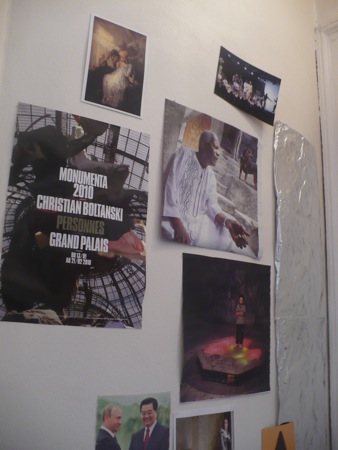
A lot of the decoration was concert announcements and seemingly random images.

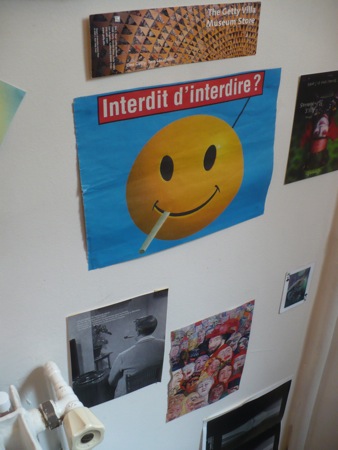
There were also some mock-political slogans. “Work less to earn less and live better” (travailler moins pour gagner moins et vivre mieux) is a parody of Sarkozy’s “Work more, earn more” (travailler plus pour gagner plus). Interdit d’interdire? takes a bit more explanation: it translates as “Forbidden to forbid?” which is a famous 1968 slogan, but obviously the joke is that it’s juxtaposed with an image of a smoking smileyface, as if to say: you don’t seriously want to forbid forbidding something as unhealthy as smoking, do you, radicals?

Some essential technologies for hygiene and body care: toilet paper, air freshener, a radiator for the winter. (I know someone out there is going to be saying: what is the point of anthropology if the best it can do is tell us that the French use toilet paper? To which I reply: As an anthropology blog, part of the goal is to remind us that what’s taken for granted one place is nonetheless far from universal. Laura Pearl Kaya reports that in Irbid, Jordan, for instance, toilet paper is “an amenity generally considered disgusting… and rarely found outside of tourist hotels” [2009:263]. Even in France, as every tourist knows, a toilet seat is far from universally supplied, particularly in public toilets.)

If we look more closely at the art next to the toilet paper, we see a postcard entitled “The world as seen by the French.” The different parts of the world are labeled as follows. Europe: “Euroland.” Russia: “Bigger drinkers than us.” Mongolia: “Lots of emptiness.” Eastern Siberia: “We’ll never be going that way.” Turkey/Middle East: “Scary zone.” India: “Lots of little people.” China: “Cause of all our woes.” Japan/Philippines: “Live animal eaters.” Australia: “Very far away.” Mauritius: “Little piece of France very far away.” North Africa: “Former colonies.” Sub-Saharan Africa: “Incomprehensible zone.”
Antarctica: “Terra incognita.” Southern tip of South America: “Home of Nicolas Hulot” (who’s apparently an environmental activist). Brazil: “Machucambos Country (indian musical groups).” Colombia: “Wicked FARC.” Guadeloupe: “Little piece of France very far away.” America: “New friends.” Canada: “Incomprehensible cousins.” Somewhere in the Arctic: “Santa Claus’ Country.”
I won’t get into a long commentary on this little image, but suffice it to say that it falls within the genre of this kind of maps; it involves a deliberate use of national self-stereotyping; and it invokes an interesting sort of national surrealism. It’s tacitly saying, in other words, that every nationality has its own, inevitably distorted, inaccurate, hyperbolic way of looking at the world. And it’s interesting to me that even in a space as tiny and enclosed and private as this toilet there’s an image of the world. As if even the smallest, most confined, most ostensibly instrumental and even profane spaces sometimes find themselves becoming scenes where the world gets presented as a totality.


Here at right we have the one potentially controversial image in this whole series: a silly photo of scantily clad men in towels labeled “Gay Saturday at The Baths.” I was ready to just accept it as one of the larger series of silly images, but soon after I moved in, one of my two (former) roommates made a point of saying something like, it’s not me who put that one up, don’t get worried, it’s just a joke or something like that. To make the most blindingly obvious interpretive comment about this, we see here that certain representations of sexuality are potentially threatening to the heteronormativity that pervades Parisian male youth culture, and hence evoke moments of boundary maintenance like this one. The message apparently being: Don’t worry, no one’s gay here. I guess if you wanted to meditate about this further, you’d have to think about how sexuality, privacy, intimacy, and bodily functions all get wound up together in spaces like this one.

I liked this poster, which is for the French publisher (called l’école des loisirs) of Where the wild things are.

Obligatory Beatles poster. To me, what’s interesting about it is its visual composition: we have here not just an image but an image of images, a compound image.

And to make matters even more analytically curious, I discovered that this particular toilet is — as ridiculous as it sounds to say this — a kind of reflexive space, a space that reflects back on itself, a space that represents itself to itself. Because on the back of the door was a photo of this very same toilet — presumably taken at the beginning before anything was put up on the walls. An image of toilets past, I suppose.

There were a bunch of other images of this apartment, of the roommates hanging out together, and of their living spaces. These two were photos of the living/dining room: a series of representations of the apartment itself as a domestic and social space. Of course, everyone including me has now moved out, so all this is gone now. They hadn’t found new tenants, so the place is probably sitting empty at this very moment, as I write.
I just want to end with a couple of broader observations about toilets. As American anthropologists recall from Horace Miner’s Body Ritual among the Nacirema, the (Western) toilet is a deeply profane space, and — as Miner observed fifty years ago — “excretory functions are ritualized, routinized, and relegated to secrecy.” That mostly holds true for France (with the major exception of male public urination, which is very widespread). Admittedly, there’s a whole economy of toilets here: there are people who make their living as public toilet attendants, collecting something like 35 cents from each visitor, and Paris famously has these peculiar self-cleaning public toilets scattered throughout the streets. Far from being totally private spaces, the shared public toilets create boundary zones between public and private, between physical intimacy and social distance. But they’re still deeply instrumental spaces, toilets: one associates them with what one can call in English “bodily functions” or in French, apparently, “faire ses besoins” (roughly, doing one’s needs). Which is why it becomes anthropologically interesting that a toilet would get so decorated, becoming as much an aesthetic space as a place for pure corporeal functionality. Along with the visual art, for that matter, there was an enormous pile of newspapers, which indicates that certain of my roommates spent long periods of time in this small space.
What does all this have to do with universities, you ask? Well, first of all, as a room in a student apartment, I reckon it falls under the broader rubric of “student culture” and hence deserves our attention. (Two of the three long-term residents here were students; the third was a recent graduate.) Indeed, universities themselves have toilets — ones which, in the badly underfunded French university environment, have sometimes become cause for consternation. So in a purely empirical sense, I’d point out that even the little temples of “bodily functions” constitute part of the institutional and social arrangements of academic culture.
But beyond that, it seems to me worth recalling in closing that, if it seems particularly inane to comment on toilets in connection with universities, that in itself is only a sign that we still live in a world built around a deeply felt opposition between the “higher” life of the mind and the “lower” needs of the body. I guess the hyperbolic way of putting this argument would be: there could be no universities if there were no toilets. Partly that’s just for simple biological reasons, of course. But it’s also true inasmuch as the cultural divide between mind and body — which the university embodies institutionally and draws on conceptually — would simply make no sense if there were no embodiment of the lowest and most corporeal side of things. For the university to be a very highly valued cultural institution, there must also be a very disvalued and stigmatized cultural institution to stand in opposition.
Seriously, though, I’m half kidding.
]]>But what I wanted to write about, briefly, was a little exchange I discovered in Critical Inquiry from 1999 between Dominick LaCapra, an intellectual historian, and Nicholas Royle, an English literature professor. The year before, LaCapra had written a fairly critical response to Bill Readings’ well-known 1996 book, The University in Ruins. In his earlier 1998 essay, LaCapra notes that Readings’ claims of “ruin” are hyperbole, and he goes on to make some very sensible points about Readings’ tacit theory of institutions and his forms of evidence. Here’s a typical passage:
Readings’s very understanding of institutions is largely conceptual rather than oriented to institutions as historically variable sets of practices relating groups of people. His perspective on the institution and what he considers institutionally relevant thus seems very high-altitude in nature. In this approach… Readings relies not on studies of the institutional functioning of universities but on a decontextualized reading of such figures as Kant, Humboldt, Arnold, and Newman. These figures did elaborate paradigms or normative models, at times embodying critical and self-critical elements, and these models may have had a problematic relation to institutional practice that varied over space and time. But what that relation was, including the differences between model and practice, is not immediately obvious. (1998:38)
This strikes me as wise methodological advice for anyone who wants to understand what a university is and how “the university” relates to the various ideas that actors have about it. LaCapra argues, in short, that one has to look at the relations, gaps, tensions, between discourse and practice. But what strikes me as hilarious, and what drives me to write this blog post, is how Royle writes in his response to LaCapra the year after. In short, Royle gives a flawless performance of what I recognize, from essays I read in college, as stock deconstructive rhetoric. Here’s the start of Royle’s essay:
In his extremely measured and seemingly even-handed essay, Dominick LaCapra recalls Jacques Derrida’s well-known (though still perhaps inconceivable) proposition that “one must begin where one is” (p. 50).[1] He does not recall the more difficult and disconcerting supplement that accompanies it, that is to say “Wherever we are: in a text already where we believe ourselves to be” (“Quelque part où nous sommes: en un texte déjà où nous croyons être”).[2] To be already in a text, that is to say, in a context, is to be in ruins.[3] It is to have to reckon with a thinking and an affirmation of ruination at the origin. As Derrida has observed: “In the beginning, at the origin, there was ruin. At the origin comes ruin; ruin comes to the origin, it is what first comes and happens to the origin, in the beginning. With no promise of restoration.”[4] An affirmation of this experience of ruination is, as Derrida says, “experience itself”: the ruin “is precisely not a theme, for it ruins the theme, the position, the presentation or representation of anything and everything.”[5]
How do you feel about this passage? Yes, I’m serious. I want to hear your reactions. But since, alas, I can’t find out without finishing this post first, I’ll start by telling you some things that strike me about this passage.
- It starts out with utter sarcasm about LaCapra’s text; seemingly even-handed is basically academese for ridiculously unfair.
- Derrida is cast in a very strange way: as at once a sort of nearby interlocutor, someone who needs no introduction and whose propositions are “well-known,” but also as an absolute authority whose (in fact controversial) claims can be cited as if they were self-evident truths.
- It’s unclear why it would be an inconceivable proposition to “begin where one is,” and Royle makes no effort to explain what he means.
- Moving on to the second sentence… I note that being “more difficult and disconcerting” is cast as an obviously good thing.
- In passing, this is an incredibly scholastic bit of prose: every sentence ends in a footnote.
- Royle cites Derrida to the effect that we are (presumably always and everywhere) “in a text already.” (He also quotes the French original to no apparent purpose.)
- He needs to assert that we’re already in a text so that he can then claim, in the third sentence, that texts are themselves contexts. If there is nothing outside the text (are we far enough into the Derridean ritual incantations yet?) then, presumably, LaCapra’s “differences between model and practice” don’t exist, or at best can only be rephrased as mere differences between one text and the next.
- Having claimed that contexts are themselves texts, Royle can then present us with the fantastic metaphor, presented however as a seemingly literal claim, that being in a text is already being in ruins. My point here isn’t that we ought to strive for non-metaphorical thought — anyone who believes that should try reading George Lakoff — but rather that Royle fails to acknowledge the metaphorical status of his own claim.
- (Incidentally, I observe that Royle has casually slipped from Derrida’s voice to his own, blending one with the next.)
- In sum, Royle’s initial retort to LaCapra’s paper appears to be something like this: If all being involves being in a text, which involves being in a context, which is itself a text, and all being in a text involves being in ruins, then Readings can’t be accused of hyperbole in claiming that the university is in ruins. For we’re all always already in ruins.
- I’m tempted to point out that Royle himself is appallingly hyperbolic here, but as it turns out later in the essay, Royle is already well aware of his own hyperbole. I won’t quote the whole passage, but he tries to avoid the patent hypocrisy of his hyperbolic reaction to (what he views as) LaCapra’s hyperbolic reaction to Readings’ hyperbole by asserting, feebly, that “there is hyperbole… we could say, as soon as there is text” (fn. 11). Royle, of course, makes no effort to substantiate this sweeping statement.
- If we go on to read the last few sentences of the passage I quoted, we get a sense of the way that this Derridean language seems to constitute a limited, abstract literary cosmos, one which seems to have a strong aesthetic appeal for writers like Royle. A Derridean utterance like “At the origin comes ruin” certainly sounds mysterious; it has the patter of poetry; but it becomes a blunt form of thought, an intellectual anaesthetic that blocks us from distinguishing different origins and different ruins. There’s something Pavlovian about it, come to think of it: it’s as if, every time anyone uttered the word “ruins,” Royle were obliged to respond by citing Derrida to the effect that we’re already ruined. As if Derridean language makes its intellectual world less by persuasion or dialogue with its critics than through sheer force of repetition. A sad fate for a intellectual project that often wanted to be more discriminating, to read more carefully, than any other.
- Just to pick out one last quality of this Derridean style, I’m struck by the casual reference to something like “experience itself,” which apparently can be entirely defined (by Royle) as “an affirmation of this experience of ruination.” Really, all experience is an experience of ruination? This is a kind of writing that talks freely about extremely abstract entities and takes pleasure in giving lots of paradoxical definitions, but it’s simultaneously theoretically committed to the impossibility of ever defining anything. It’s a theoretical language that revels in its own paradoxes.
Now, LaCapra obviously was seriously annoyed by Royle’s critique (which went on for several pages). His 1999 response to Royle is one of the more witheringly comic bits of academic prose I’ve read in a while; it has moments like these:
I would begin by noting the seeming condescension in his tone of the initiate. This tone has become familiar in a certain discourse that seems to situate itself both textually and contextually somewhere between meta-metaphysical hyperspace and Planet Earth (conceived of course in appropriately global terms). This labile (non)position of the Luftmensch allows for rapid gliding between quasi-transcendental critique and historical (or pseudohistorical) commentary.
[In response to an argument that LaCapra is US-centric:] If Royle really has something to say about other university systems that would contradict or qualify my argument, it would have been enlightening for him to have said it.
[In response to Readings’s and Royle’s advocacy of short-term, non-institutionalized structures:] A university made up only of self-styled anti-institutional institutions of short duration could be the realization of the superbureaucratic, transnational manager’s wildest dream—the ideal place for the blissful rendez-vous of such an apparatchik with the Deleuzian nomad following a ligne de fuite.
[In response to a claim that LaCapra ignores students:] Royle asserts that “in a sense, students do not exist” (p. 152). I shall resist the invitation to sustained irony this formulation holds out and simply observe that in another sense they do indeed exist.
[In conclusion:] Readings’s book was striving for something while Royle at times seems to equate thought (or is it Thought?) with rather predictable, in any case “undisconcerting” and histrionic, verbal gestures.
So in the end it doesn’t appear that Royle managed to persuade his opponent of anything of substance. Instead, he managed to call attention to his own textual performance. But for me, this whole exchange elicits above all a feeling of the rapid passage of time in academia. It strikes me that I very seldom see anything from the last ten years written in the Roylean style — that style where Derrida is a vast authority yet close at hand, where certain kinds of universal claims (for instance about “experience itself”) combine so readily with a fixation on the irreducibility and undecidability of texts, where a certain form of in-group irony passed for the height of intellectual sophistication. I don’t even know if most grad students my age have encountered this Derridean style — it was a staple of undergrad literary theory education when I was in college, but that was a while ago and may have been particular to my undergrad institution. At any rate, it’s not a style I’ve really encountered in the humanities at Chicago where I am now (though admittedly I’m not in a humanities department). Does anyone else get the sense that this sort of deconstructive writing is now slipping away into the archives?
]]>| Accommodation | €105 (€35/night * 3) |
| Student conf. registration | €90 |
| Obligatory EASA membership | €50 |
| Roundtrip airfare to Dublin | €150 |
| Very cheap meals from restaurants | €45 (€15/day * 3) |
| Total | €440 |
|---|
By contrast, you could rent a room in Paris for an entire month (my rent is €400) for less than the sum cost of these three days. Yes, a month’s rent: which, from a student perspective, is a rather amazing sum of money. It’s enough to make one think that major academic conferences like this are structured around a sort of tacit class exclusion. They do, of course, have some participant funding available, but it apparently comes to €20,000 for a conference that’s supposed to attract more than a thousand people.
]]>This happened in 1860 in Aberdeen. The students wanted Sir Andrew Leith Hay, the ‘local candidate’, and there was in fact a numerical majority for him, since the numbers in the ‘nation’ which comprised the Aberdeen constituency were greater than those in the ‘nations’ which came from outside Aberdeen. Reckoned by ‘nations’ and not by numbers, there was a tie between Hay and Maitland, the solicitor-general. The principal gave a casting vote in favor of Maitland. This was taken as a deliberate move to back the professors against the students. In March 1861 Maitland came to deliver his rectorial address. The academic profession, along with the magistrates and the town council, entered the hall. Cheering, hooting and yelling greeted their appearance; this was to be expected: it was the traditional accompaniment to every rectorial address. But then the scene became ugly. Chunks of splintered wood hurtled across the hall. The audience were, of course, expected to come unarmed, but some of them had brought in hammers and other instruments with which they uprooted the seats and smashed them into pieces suitable for projectiles.
The principal took his place at the rostrum and called on the meeting to join him in prayer. Out of respect for the kirk there was a temporary lull. But the uproar resumed as soon as the oath was administered to Maitland, and he stood at the lectern to give his address. At this point some of the professors left the platform ‘to remonstrate personally with those taking a leading part in the row’.The rector kept smiling and endeavoured to proceed with his address, but at this stage blood was trickling down his face. The more respectable students were ashamed, and added to the pandemonium by hissing. There were cries of ‘Call in the police’. After ineffectual intervention by the principal, several police were ‘brought up to the hall door, but no force was used by them. . . ‘. The rector calmly and impressively completed his oration, the principal pronounced a benediction, and the proceedings, ‘which had lasted upwards of two hours’, were brought to a close. (20-21)
I’d like to imagine that these days outright violence is no longer a part of university politics, but there are just too many counterexamples to take that claim seriously.
]]>For example, consider the metro station that I was talking about in my previous post.

As the train approaches on the far track, a decent thicket of people accumulate on the facing platform. They face every which way. They form a long line with denser and emptier patches. They jockey for position on the platform or traverse it aimlessly.



The train inevitably pulls into the station.

After which it inevitably leaves.


And after it departs, the crowd is erased as if a rolling eraser had been wiped along the platform leaving nothing but a few stray bodies where formerly there was a horde.
Needless to say, my point here isn’t to be naive and pretend that something magical happens when a bunch of people get on a train. My point, however, is that at a sheerly visual level it’s quite a strange phenomenon. Visually, the people just vanish. Are effaced with the roar of the clattering wheels.
Not to mention that the social situation in the station is transformed in a matter of moments. Suddenly there’s solitude. The initial sense of getting scratched up by the thorns of a thicket of a crowd’s anonymous gazes gets replaced by an almost peaceful loneliness. One feels the absence of that curious mass expectation that always mounts up as a train approaches; all there is, instead, is a handful of plaintive souls hastening to climb back up the stairs to the street level. The large group that formerly waited together for the train in a mass demonstration of collective purpose gets replaced by a cluttered mass of individuals who immediately go off in separate directions.
This phenomenon occurs, repeats, repeats, repeats again. The light shifts on the arched roof of the station and shifts again, as the crowd casts shadows and the train catches the light. But you don’t see that, because your own train has probably arrived before you can observe many trains pass on the opposite track.
On the metro, there are further surrealisms that everyone ignores for the greater glory of the cause of minding their own business. Lights and lost spaces streak by in the tunnel. Hisses and roars and sometimes the smell of anomalous chemicals, like the intense smell of sulphur just north of Carrefour Pleyel in St-Ouen, come and go without comment.
It’s enough to make me feel that there needs to be some sort of theory of mass inattention to the mysterious. A theory of the regimentation and sterilization of urban perception. A theory of the way things become mundane.
]]>
(Photo by Imen I., a student in sociological methods at Paris-8.)
The title at the top reads “Some people are pretending that students don’t have housing problems.” The caption in blue on the photo says that “Damien and Mélanie, 22 and 23 years old, each still live with their parents.” You can’t really read the bottom, but it informs you that UNEF, the biggest student union in France, demands students’ right to housing. (Relevant background information: there’s a major shortage of dedicated student housing in the Paris area.)
This poster has, as far as I’ve seen so far, tended to shock and irritate campus-dwellers more than it attracts support for its ostensible cause. It depicts a young couple having sex in a parental bed while the parents are sleeping. The couple is similar, they both look pale-skinned, they both have dark hair, they’re both equally nude. The sex is hetero although, since the girl is on top, it is slightly less normative than it might be. I don’t really have a good point of cultural reference here, but for lack of anything better, French wikipedia claims that “La plus courante est la position du missionnaire.” Anyway, the boy’s body is stretched out on the bed and he’s gripping his partner’s head and thigh with his hands; the girl seems to be holding herself up with her left arm. It looks like they’re kissing, and the boy’s eyes are shut. I hope he hasn’t fallen asleep.
The parents are sleeping. Or are they? The old man’s sleep mask hints that it takes an effort to stay unconscious. The parents are turned away from the middle of the bed as if trying not to pay attention, trying not to know; if this were a real scene, they would at best be pretending to be asleep. They’re wearing nightclothes that blend into the bedding, as if symbolically they were only the unwanted backdrop to the sexual act in progress, to the young couple’s bodies that, compared to the rest of the bed, are so much more visible and so much more saturated with color. The bodies of the young couple seem to be physically right up against the bodies of the old couple, the girl’s right side fitted into the curve of the old man’s curled-up body, the boy’s shoulder possibly propped up on the old woman’s back. But at the same time, the bedding (that garish quilt) seems to act as a physical and, by implication, a symbolic barrier between the young and the old couple. It seems to maintain a minimum of physical separation even as the whole scene emphasizes the reckless and scandalous closeness of the children’s sex act to the parental bed. Taboos are being broken in this image, but only within limits.
The image is organized in such a way as to manifest a series of oppositions between the two couples:
| Parents | Children |
|---|---|
| Old | Young |
| Clothed | Nude |
| Asleep | Copulating |
| Corporeally rather limp | Corporeally active |
| Physically apart (arms folded, physically closed in on themselves) | Physically intertwined (arms wrapped around the other) |
| Apparently indifferent to each other | Passionately connected |
| Facing apart, back facing back | Facing each other, stomach against stomach. |
| Horizontally related: next to each other | Vertically related: one on top of the other |
| Separated by the other couple | Separating the other couple |
The bodies of the young couple serve here to divide the old couple from each other. Here the young mediate and interrupt the old: symbolically, this looks something like an allegory of the way that children’s sexual relations interfere with their elders’ relationships, of the way that inter-family sexual relations interrupt intra-family (kin) ties. One of these young people is presumably the child of the sleeping parents; but here this person, whichever it is, is represented not as the child but as a member of a new couple opposed and probably annoying to their elders.
At the same time, it has to be said that both couples are obviously very similar in some ways. They both look white. They both look straight. And although only the young couple is having sex in this picture, we can infer that the old couple was, at a previous time, also having sex, since we can assume that that would have been the social and biological origin of one member of the young couple. In that light, the old couple should perhaps be viewed as “post-sexual” more than “asexual,” as the sleepy remainder of past scenes of sexual passion. It comes to mind that the only thing really taboo about this scene as a social situation is that the young couple is in the same bed as the parents. Aside from that, it’s a textbook image of hetero sociosexual reproduction. One couple produces a child who forms a new couple which in turn strives to produce a new child… That’s about as normative as it gets, on my understanding of French social order.
Now, although it seems to me that everything I’ve just said about the image is basically obvious, is basically something that one can read in the image without a great deal of interpretive risk, it must be said that, to the best of my knowledge, none of these considerations figure in local interpretation of the poster where this image appears. No one I’ve met sees this as a picture that deeply invokes norms and scripts of social reproduction; my sense is that local interpretations start and end with a scandalized sense that it’s a picture of a couple having sex. The depiction of sex — at least in the fairly unrelated context of a student housing campaign — is viewed as a scandal in itself, end of thought. Or perhaps just as a tasteless bit of political advertising. Someone told me: maybe this would make sense for a condom ad, but here!?…
The implicit logic of the poster, of course, is something like: “for lack of adequate student housing, students have to live at home; thus they have nowhere to have sex but their parents’ bed; which is absurd and scandalous; hence the current housing shortage leads to scandal and demands action.” It’s a logic of political shock, quite likely designed to catch the eye and stick in memory more than to elicit any direct political action. And insofar as it has indeed caught the eyes of the campus (a long row of these posters is put up in a series by the solitary university entrance), it seems to be, paradoxically enough, a success. The scandal represented in the image becomes the scandal of the image itself.
]]>
Actors in masks, some with stockings over their heads, made a pretend argument for burning the university. For the foreigners in the audience, a disjointed translation of their performance was projected on a screen like so:
We want Godard, Proust, the Princess of Cleves, not commercial trash culture
Let us burn the university! No! The University is not for profit! It is there to create more freedom, more riches (that are not material), “Latin is useless and that’s why it’s beautiful!” against the death of “dead languages”, let us burn the university! In the name of all erasmus students, I would like to say I had no time to write a speech, because I work to pay my way and so we say “let us burn the university”!
[They shouted their discourse from the stage.]
Experiment time! First we will build a fire, the first spark. Take your sheet of paper, fold it over, then again, and cut it, and lick it and keep your strip of paper (etc),
[The actors circled back into the aisles of the large lecture hall with sheets of paper, with which they mimed an effort to create fire.]
It doesn’t work!!!!!
[—they said as they pretended to discover that rubbing two pieces of paper together doesn’t make a spark.]
It would be crazy; it would be like killing oneself; like putting one’s head in the freezer, like throwing oneself under a car, like…
[As if they were delighted to discover that they didn’t need to burn the university after all… but the translation trailed off and the actors came through the aisles hugging the audience. Even including the ethnographer, yours truly.]
The more serious debate went on with a panel discussion.
However, among the panelists was the university president. And every time he opened his mouth to speak, people in the audience booed and hissed. He waited for them to finish; the moderator made failed pleas for civility; he spoke some more; his face became agitated.

In essence, his speech was a failure, blocked by the crowd. “By anarchists,” someone claimed later. He didn’t stay to the end of the debate, leaving by the side door soon after his (interrupted) speech had come to an end.
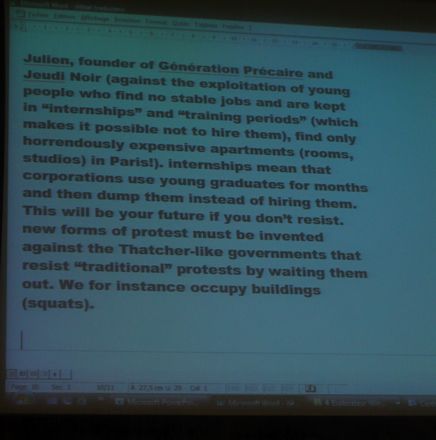
One of the other people talking was a representative of a squatter campaign. He explained to us that squatting had the advantages of being exciting and rent-free, but that, of course, there were “strong chances of legal trouble”… at any rate, I was interested in his negative comments on traditional protest forms. “Internships mean that corporations use young graduates for months and then dump them instead of hiring them. This will be your future if you don’t resist. New forms of protest must be invented against the Thatcher-like governments that resist “traditional” protests by waiting them out.”
And this has indeed been one of the common remarks about last spring’s university protests: that traditional protest forms (i.e., street marches) seem ineffective against a government that can simply ignore them.
Now looking back up into the auditorium, we can see one of the protestors standing up. He was shouting about the undemocratic format of the event and about how the voice of the audience had been excluded. The original format dictated that panelists spoke first, followed by “invited” audience comments, and finally general comments. That fell apart when the “general” audience wanted to speak sooner: after the speech you see pictured here, the event never returned to the sedate form of a well-groomed public event. Rather it hissed permanently with the noise of loud conversations among the audience, it hissed with interruption, it hissed with anger and incoherence.
Incidentally, it doesn’t look like such a large crowd in this photo, but there may have been a couple of hundred people there all told.
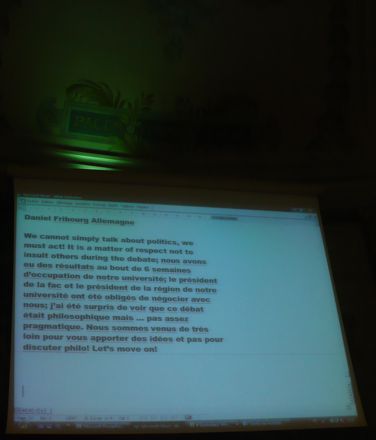
A number of foreign activists were present. At the end, an Austrian fellow took the stage to give a sweeping critique of the chaos of the event and to express a general sense of disappointment. He was speaking English, so the translation was into French. I’ll translate back:
We cannot simply talk about politics, we must act! It is a matter of respect not to insult others during the debate; we’ve gotten results at the end of six weeks of occupation of our university. The presidents of the university and of the region were obliged to negotiate with us. I’ve been surprised to see that this debate has been so philosophically oriented… and not adequately pragmatic. We’ve come a very long distance to bring you ideas and not to talk about philo[sophy]! Let’s move on!
Since I’m interested in the relationship between philosophy and politics, this last remark interests me. It seems to say: philosophical discussions are antipolitics. Philosophy discussions are a withdrawal from action. Philosophy is mere metadiscourse.
A minute later, someone, perhaps the protestors in the audience, set off firecrackers in the auditorium. Naturally, everyone jumped up out of their seats. (Including me.) We waited anxiously to see what would happen; another little explosion went off, even louder than the first. The crowd became muddled and people started to walk out. The security personnel showed up on the stage and waited outside in force. Someone made a half-hearted proposal to “occupy” the Sorbonne but I don’t think it got anywhere. At any rate, I got out of there and went home, not even stopping like a good ethnographer to survey other participants on their reactions.
]]>Now I could tell you all sorts of other things about how my home university, a very rich private American university, is different from the French public universities I’ve encountered. But I’ve looked up some figures and, frankly, the sheer quantitative difference between Paris-8 and UChicago is so enormous that it almost speaks for itself. Behold:
| Paris-8 | UChicago | Ratio | |
|---|---|---|---|
| Students | 21,487 | 15,149 | 1.4 : 1 |
| Faculty | 1,075 | 2,211 | 1 : 2.1 |
| Staff | 601 | ~12,000 | 1 : 20 |
| # Buildings | 11 | more than 190 | 1 : 17 |
| Annual Budget | €119.3 million | $2.8 billion | 1 : 16.8 |
| Endowment | None | $4-5 billion | — |
As you can see, there are actually 6,338 more students enrolled at Paris-8 than at the University of Chicago. However, the balance tips the other way for every other indicator. In Chicago there are twice as many faculty (for fewer students), twenty times as many staff, and seventeen times more campus buildings — which is probably an underestimate, since UChicago also owns a lot of residential and commercial real estate in its neighborhood over and above the campus buildings. UChicago’s annual budget of $2.8 billion is also about seventeen times larger than that of Saint-Denis, and of course, UChicago controls an endowment of 4+ billion dollars while Paris-8 has an endowment of, as far as I know, zero. (French universities don’t have endowments; and much of their funding is dispersed directly by the ministry, though that’s changing as a result of contested “autonomy” protocols being put in place. The Chicago endowment on the other hand used to be $6.6 billion, though they claim it shrunk as much as 30% during last year’s economic crisis.) At any rate, I think the overall picture here is clear: the disparity in organizational wealth is enormous. The disparity in teacher-student ratios is obvious. The disparity in staff, money and buildings is even more obvious. This isn’t, in short, just a story about simple difference; it is a story about profound educational inequality within and between nations. If we imagine a similar 17x disparity between two American workers, it would be similar to the difference between someone who makes $15,000 working minimum wage in a fast food restaurant and someone who gets a quarter million dollars a year as an executive.
The whole long international history of how these different universities came to be so economically different is something I can’t get into here. And there are, for that matter, some interesting commonalities between the universities that aren’t obvious from the official statistics. For instance, I happen to know that the official count of the staff population is probably too low in both cases, since both universities employ significant groups of outside contractors to do various sorts of campus service work. While Paris-8 has private security guards, UChicago has, for instance, outsourced its janitorial staff; and these people should probably be counted as staff, because they are regular campus workers even if their paychecks are routed through some private entity. The faculty counts are probably unreliable as well, since both campuses hire teachers who are graduate students and, in Chicago’s case, temporary adjunct faculty who probably aren’t being counted in the official size of the faculty population. (This is, of course, just a guess; I don’t know for sure how they compile these figures. But it’s well-known that, in the U.S. case, there are various reasons why administrators don’t like to count grad student teachers in the ranks of their teaching staff.) At any rate, it’s anyone’s guess whether the systematic skewing of these figures would cancel out across these two universities in the context of the comparison here.
In a lot of ways it’s an unsatisfying comparison. Similarly vast wealth disparities could be found by comparing UChicago to an American community college. Still, even leaving aside all the cultural and intellectual and sociological and historical and political differences that separate UChicago and Paris-8, leaving aside everything that you would have to consider to make a comparison satisfying to an anthropologist, even just looking at the most crude and basic figures, it’s worth thinking about the extent to which campus life is bluntly determined by available wealth. Indeed, maybe it’s good to start out by thinking about the gross inequities in material resources across universities. Maybe only once you’ve taken account of that can you really understand how some kinds of academic life depend on large fluxes of cash or, conversely, manage to flourish in spite of them.
]]>Colleges and universities should never underestimate the power of special, transformational, and even sacred spaces on their campuses… Universities are products of history and tradition. Not only are they institutions of scholarly learning, but they also are sites of memory and meaning, with cultural spaces that have played host to decades or even centuries of ritual.
…Such transformational places with unique emotional resonance have an almost sacred nature. The word “religious” comes from the Latin verb religare, meaning to bind or reconnect. Thus, anything that reconnects us is, inherently, a deeply personal or spiritual experience that has great meaning — and the university campus is ripe with opportunities for people to reconnect.
…Elite universities understand the importance of branding in creating long-lasting loyalty among students, and they use very specific and often-repeated images in such efforts… such imagery typically has very little to do with dormitories, classrooms, libraries, or students working late into the night. Most images focus on the campus as a landscape, with views of special buildings, students walking or lounging on an open green, and, of course, football players or bands performing on the stadium’s holy ground.
So the sacred spaces on campus are something to be branded. Something to be created as a spectacular image that will produce “unique emotional resonance,” that will give us a “deeply personal or spiritual experience that has great meaning.” This Orwellian language deserves, I think, to be stood on its head: “unique” here really means “totally generic,” and “deeply personal” amounts to “totally determined by cunning advertisers.” For there is after all nothing personal in a pre-scripted contact with the sacred, except through the medium of delusion.
Sacred space in this discourse basically serves two instrumental ends: to create “great meaning” and to increase the university’s bottom line by stimulating alumni donations. Broussard continues:
Alumni of those institutions and others whose campuses have transformational and sacred spaces return to a wealth of traditions and reconnect with their alma mater, which is integral to giving back to their respective schools. Students who attend commuter institutions are not as likely to form the same kinds of emotional attachments, and as a result such institutions miss out on fund-raising and other opportunities associated with having a robust, dedicated, and committed alumni base.
… Once these places have been identified, it is essential to reinforce their function and develop their storylines. What is the history of the site? What meaning does it have? Tell that story by using signage, seating, plantings, art, and paving — elements that support but do not destroy the place’s uniqueness. This offers a great opportunity for fund-raising programs: Storytelling becomes a cultural-support system and should be treasured and nurtured by all parties.
Here we have the new culturalist advertising: it’s slicked up with a rusty anthropological language of meaning and ritual, as if ’60s Victor Turner-esque anthropology had provided a new marketing jargon for the early 21st century. Broussard is of course the president of a landscape consulting and architecture firm, so the article seems to amount essentially to a piece of free advertising for his service, courtesy of the Chronicle of Higher Ed. I hate to talk about the “commodification of higher education,” since the very phrase seems to embody a political bias that precludes rather than enables further analysis, but sometimes there are cases, like these, that seem to fit the category too well to give it up.
]]>My daughter is a senior from a public school with a class size of 589. She has a 4.0 GPA with mostly advanced and AP classes, except required classes. She has an SAT of 2,250, ACT 36. So she is a National Merit finalist, President Scholar candidate, and a winner of MI Southeast Conference All Academy Award (only five students in her school win). She is a cellist in symphony orchestra and a varsity crew member on the rowing team.
Yet she was rejected by four Ivy schools and put on the waiting list for the University of Chicago. What went wrong? Her counselor was stunned by her rejection. What should she do to get off the waiting list?
…
Answer:Your daughter sounds like a terrific scholar, musician, and athlete. The world of selective college admissions is so hyper-competitive that trying to read the tea leaves about why decisions were rendered is almost impossible…
One feels sorry for the daughter, she is such a quantitatively perfect person. Her SAT score is higher than most graduate students’ monthly incomes. She has perfect grades. She has perfect stats. She has more honors and decoratations than a military veteran. She comes from a public school, so she isn’t too marked by obvious badges of class status. She appears, at least to her parent, as a completely flawless unit ready for insertion into what was, evidently, expected to be a flawlessly meritocratic system.
Such was the strength of the expectation, that perfect preparation equals perfect success, that its failure provokes a moment of stunned incomprehension. “What went wrong?” On one level, this question is rhetorical, even performative: the parent already knows what went wrong: their daughter didn’t get in where she was supposed to. The very question what went wrong? presupposes an assumption that the daughter could not possibly have been rejected, projects an image of a world that functions automatically, a giant sorting system in which the best reliably get what they deserve.
The system is fake, to state the obvious. For one thing, because the qualities that make one a perfect student are themselves not evenly distributed from equal starting points; rather they’re a function of family background, class status, home town, gender, race… The response to her letter read in part: “Gender does play a role and it is simply more competitive for young women at most places these days.” I wasn’t aware of that but I guess it’s not surprising, given statistics that more women than men are going to college.
But these kinds of systematic biases are relatively minor flaws in the meritocracy compared to its real problem, which is that sometimes it just doesn’t produce the reliable result one expected, sometimes it doesn’t pick people who seem to be the best, sometimes its results are shocking, random, arbitrary. This arbitrariness is understood by the people making the choices between applicants, I think, but is viscerally felt much more by the system’s rejects.
One feels sorry for the daughter, or at least for her parent, whose fantasies of vicarious success seem to be developed to a high degree. It doesn’t seem to occur to people like these to long for a world where higher education wasn’t organized as a massive meritocracy, where the education was more even in quality across different institutions, where a few overvalued elite institutions (and I should know, having gone to two of them now) get more credit than they deserve. There seems to be no chance of a political analysis of class reproduction occurring in this situation. Ultimately, it’s not just the daughter’s rejection that’s shatteringly arbitrary, it’s the whole system of higher education that comes to appear like a castle in the clouds, a fantasy world of success more longed for than understood.
]]>But just to give some sense of the ludicrous nature of student work at private universities, in a bit of an echo of Bousquet’s argument, I want to share some quick figures that I’ve come up with. In essence, it turns out that if you’re working minimum wage jobs at private universities, you’re arguably still paying the university to be at those jobs.
For instance. When I was in college at Cornell University, the tuition began in 2000 at $24,760 and ended up in 2004 at $28,630 annually, while university-provided room and board ranged from $8706 to $9529. You could live off campus for less than that, of course, but once you accounted for books and transportation I could imagine eight or nine thousand dollars in room, board, etc, being about right. Just taking the cheaper 2001 figures, the estimated cost of attendance would have been at least $33,466.
One big employer, of course, was the library, which paid the state minimum wage, then $5.15/hr. Cornell had two 15-week terms, so you were paying $1115.53 each week thirty weeks a year. Now, there are a hundred sixty eight hours in every week. So every hour you were at Cornell, even the ones when you were sleeping, drunk, daydreaming, etc., cost you ($1115.53/168 equals) $6.64 in tuition and living expenses. And what’s absurd is simply this: if you had that minimum wage job at the library circulation desk, you were in effect paying the university $1.49 an hour just for the privilege of showing up at work. Negative net pay, when you subtracted the hourly cost of living and tuition.
For another point of reference, at the University of Chicago, where I am now, undergrad tuition is currently $12,834 per eleven-week quarter (ten weeks of class plus a week of exams). The total cost of attendance is currently estimated at an astounding $52,450 for a year of on-campus residence. This comes out to $1589.39 per week or $9.46/hour. If you work, for instance, at the door of the campus pub, you get paid $7/hr, for a net loss of $2.46/hr.
Obviously there are all kinds of complaints you could make about this calculation. You could argue that no one is paying “per hour” every hour. (Though colleges do market themselves as purveyors of comprehensive, total, unceasing experiences.) You could argue that students are getting financial aid, and that the pay from their student jobs doesn’t go directly towards tuition, but probably more towards food, drink, small necessities, merriment, and the like. OK, but we’re talking total costs versus total wages here, and we have to realize that the costs of attending these private universities are largely hidden or spread out over time. A lot of the financial aid is in loans, which are just a way of delaying the bad news and moreover appear to increase total costs through interest, and one might argue also that most of the grants come from the federal government, hence from the taxpayers, and that some fraction of the student’s future taxes are just, in a sense, going to pay back this grant.
Ultimately the point is simple. Given the relatively bad pay of entry-level campus jobs, and the extremely high cost of private education, these jobs are in fact a net loss. Think of these jobs as paying to volunteer for the university – except that instead of being in some interesting field of your choice, you’re paying to volunteer for whatever dull task they feel like giving you. And even the more skilled campus jobs – like IT jobs that pay $10 or $12 an hour – are actually much less lucrative than they appear, when you think about how much you’re paying the university every minute that you’re there. Jeff Williams has eloquently argued that modern college education is a form of debt pedagogy. But, as Williams might have stressed more, it’s difficult for college students to comprehend what it means to borrow so much money so young. He comments on the spirit of indenture that’s realized in the shackles of student loans. What about the spirit of indenture realized in jobs that pay less than zero and serve menial campus functions?
]]>
At NYU. This is a picture of an art gallery from the street. The street reflected in the background. Some random art in the bottom.
But really I was just tremendously entertained that the DEPARTMENT OF PHOTOGRAPHY & IMAGING stuck its name right next to a surveillance camera. I guess they are afraid someone might steal their images? Or at least they want to have images of people stealing their images? Or perhaps the security camera is actually part of the exhibit? The white of the camera body blends so nicely with with the white of the wall. It reminds me of a little robot that has stuck its iron fist through the sheetrock and is waving for attention.
A couple of blocks down, across the street, was a somewhat more politically disturbing image (the kind that you’d usually see on Sociological Images, not here):

A strange and outrageous marketing tactic to say you’re selling virgins. Sacrificing virgins. A primitivist fantasy right out of a bad indiana jones scene.
[Update: I only notice now in hindsight that even the ad on the taxicab appeared to be for a “gentleman’s club”…]
]]>